AI & Automation
Designing AI products that stay useful as models evolve
We write about AI, software, and the decisions that shape how modern platforms are built, scaled, and operated.
by
James S.
•

Modern software teams face a recurring tension: as products grow, infrastructure becomes more complex. Reliability requirements increase, usage expands, and systems need to support more data, automation, and integrations.
But every investment in infrastructure carries a risk — slowing down the very product progress that made growth possible in the first place.
The challenge isn’t choosing between speed and stability. It’s building infrastructure in a way that supports both.
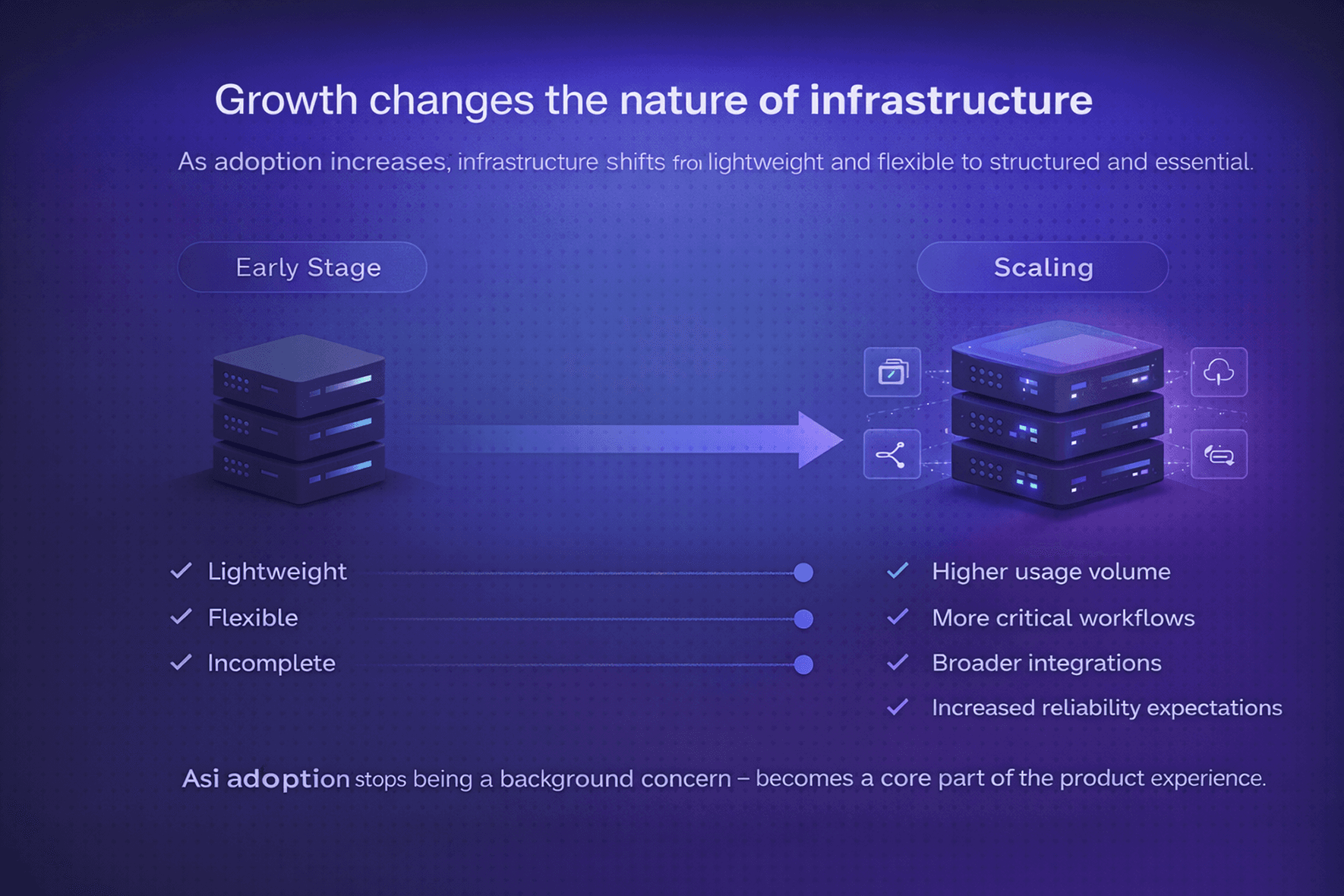
Growth changes the nature of infrastructure
Early-stage products optimize for momentum. Teams move quickly, test assumptions, and prioritize shipping over perfect architecture. At this stage, infrastructure is often lightweight, flexible, and intentionally incomplete.
As adoption increases, the system begins to carry more weight:
higher usage volume
more critical workflows
broader integrations
increased expectations around reliability
Infrastructure stops being a background concern and becomes a core part of the product experience.
This transition is where many teams struggle. Over-invest too early and velocity drops. Wait too long and the system becomes fragile.
The hidden cost of premature complexity
One of the most common mistakes is treating infrastructure as a future-proofing exercise. Teams attempt to design for scale before scale exists, introducing layers, abstractions, and tooling that slow development.
The result:
longer build cycles
harder onboarding
increased operational overhead
reduced clarity around the product itself
Infrastructure should not be a theoretical system designed for hypothetical scale. It should be a response to real constraints.
Build for what the product needs now — with clear paths to expand later.
Velocity comes from structure, not speed
Product velocity is often misunderstood as “moving fast.” In reality, it’s the ability to move consistently without friction.
That consistency depends on structure:
predictable deployment processes
clear system boundaries
modular components
observable performance
When infrastructure is structured well, teams don’t have to pause to re-learn how the system works every time they ship.
Velocity becomes sustainable, not reactive.
Designing infrastructure that evolves
Infrastructure should behave like the product itself — capable of iteration.
Instead of monolithic rebuilds, focus on incremental expansion:
Modular systems
Break capabilities into parts that can be upgraded independently.
Observable environments
Make performance, usage, and failures visible. Decisions improve when systems are measurable.
Layered complexity
Start simple. Add depth only where needed. Avoid global changes unless absolutely necessary.
Integration-ready foundations
Assume the system will connect to other tools and services over time.
This approach keeps infrastructure aligned with real product growth, not theoretical scale.
Protecting product velocity during scale
As infrastructure matures, product teams often feel the weight of operational responsibility. Releases slow down, coordination increases, and experimentation becomes harder.
Protecting velocity requires intentional design choices:
automation over manual processes
stable environments for testing and deployment
clear ownership across system components
minimal dependency chains
Infrastructure should reduce decision fatigue, not increase it.
When the system supports the team, velocity becomes a property of the environment — not just the people.
Infrastructure as a product layer
At scale, infrastructure is no longer invisible. It shapes reliability, performance, and how the product is perceived.
Users may never see it directly, but they experience its outcomes:
response time
uptime
consistency
trust
Treating infrastructure as a core product layer changes how it’s built. It’s no longer just technical support — it becomes part of the overall system design.
The balance that matters
Speed without structure leads to fragility.
Structure without adaptability leads to stagnation.
The goal is not to pick one. It’s to create an environment where:
teams can ship without hesitation
systems can evolve without disruption
infrastructure supports momentum instead of resisting it
The most effective platforms are not defined by how fast they launched or how complex their architecture became. They’re defined by how well they continued to move as complexity increased.
That continuity is what separates products that stall from those that scale.
Next up



FAQ
Frequently Asked
Questions
Is Stellr suitable for early-stage AI startups?
Yes. We launched our site with Stellr while still early-stage, and it gave us a clear structure to explain our product without needing a full marketing team.